The Stoic Ledger
What Seneca’s Letter 98 to Lucilius teaches the luxury sector about surviving its own fortune.


12 agosto 2026
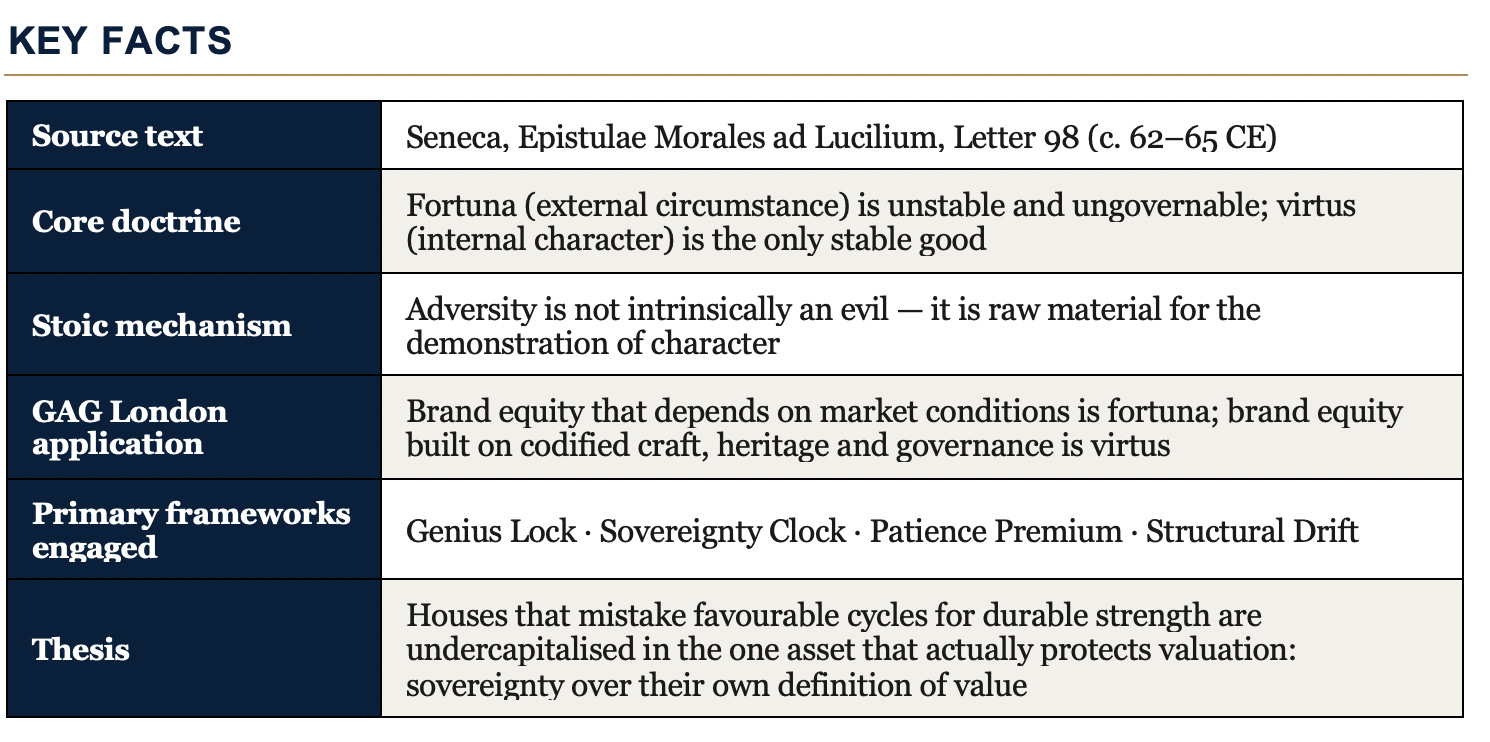
FRAMEWORK NOTE
Four proprietary GAG London terms recur below: Genius Lock, craft codified beyond competitor replication; Sovereignty Clock, consecutive contrarian decisions proven right beyond four quarters; Patience Premium, the valuation gap earned over 10+ years by houses that forgo volume for scarcity; Independence Tax, revenue forgone by declining algorithmic demand. Treat these as working hypotheses under active testing — the Falsifiable Predictions below exist to expose them to disconfirmation.
THE ARGUMENT
Seneca’s Letter 98 is not, on its surface, a document about markets. It is addressed to a friend navigating grief and reversal, and its counsel is austere: do not build your peace on anything that can be taken from you by forces outside your control. Wealth, health, reputation, and in the vocabulary Seneca would not have used but the logic anticipates market share, can all be given by fortuna and just as easily withdrawn. The only good immune to this withdrawal is the disposition of the person, or the institution, that holds it.

Read as a governance text rather than a consolation, Letter 98 describes with uncomfortable precision the condition of much of the luxury sector in 2026. A significant share of enterprise value across the listed luxury complex has been priced not on codified, transferable capability, but on the temporary alignment of macro conditions: Chinese outbound tourism, US wealth-effect spending, low rates supporting discretionary purchase, and a decade of multiple expansion that rewarded top-line growth over structural resilience. That alignment is fortuna. It was never virtus, and it was never going to be permanent.

Seneca’s second move is the more useful one for an operator. He does not counsel indifference to adversity, nor does he counsel the elimination of risk. He counsels the conversion of adversity into a test of character an argument that maps onto what GAG London’s Patience Premium framework has documented across family- and founder-anchored houses that outperformed through the 2008–2009 and 2020 downturns: the discipline was not avoiding the cycle, it was refusing to let the cycle dictate identity. Ermenegildo Zegna Group did not dismantle its vertically integrated wool-to-suit pipeline to chase faster, cheaper volume even as adjacent categories drifted toward speed and disposability. Hermès did not renegotiate its waiting lists to chase a soft period. The virtue, in Seneca’s sense, was already banked before the adversity arrived.

Loro Piana is the instructive counter-case, and a more honest one than the Zegna example above. Since full absorption into LVMH, the house’s public narrative has increasingly emphasised scale and distribution over the artisanal, small-batch fibre sourcing that built its allure a live illustration of virtus being fed back into fortuna’s machinery rather than protected from it. Seneca’s framework does not predict that integration into a larger group is fatal to virtus; it predicts that virtus erodes exactly when a house stops treating its codified craft as sovereign and starts treating it as a production input to be scaled. That is a governance choice, not an inevitability of ownership structure.
The third strand of Letter 98 concerns the opinion of the crowd. Seneca warns against calibrating one’s conduct to popular judgment, which he treats as unstable by construction it moves with fashion, not with reason. This is the least comfortable application for a sector whose entire commercial proposition is, in one reading, the monetisation of collective opinion. But the distinction Structural Drift framework draws is precisely Seneca’s: houses that let social validation set direction (chasing virality, drop culture, algorithmic relevance) are ceding sovereignty to the crowd’s fortuna. Houses that use cultural conversation without being governed by it that maintain a private definition of what the house is for, independent of trending sentiment — retain the Sovereignty Clock advantage that compounds over decades rather than quarters.
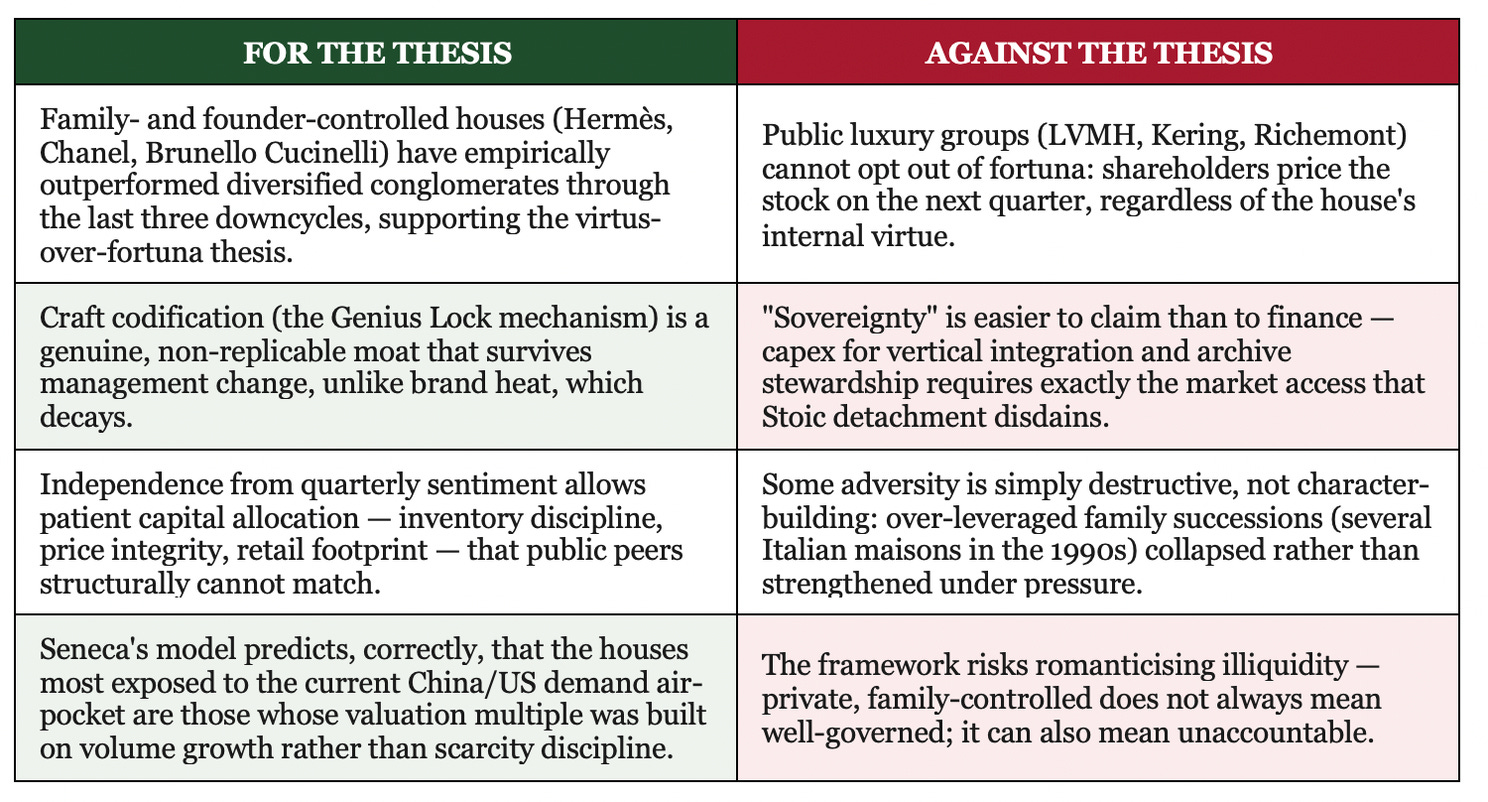
BULL / BEAR: DOES THE STOIC MODEL HOLD FOR PUBLIC COMPANIES?
ANALYTICAL NOTES
Applying the Sovereignty Clock: the metric is not ownership structure per se, but the number of consecutive product or pricing decisions a house has made against prevailing market sentiment and been proven right on a horizon longer than four quarters. This is measurable, retroactively, from pricing archives and collection records, and GAG London’s ongoing coverage treats it as a leading indicator of resilience superior to gross margin trend alone.
Applying the Independence Tax: the corollary to Seneca’s warning about popular opinion is that sovereignty is not free. Houses that decline to chase viral relevance forgo measurable short-term revenue upside the Independence Tax in exchange for long-run pricing power. The editorial error most public luxury commentary makes is treating this trade as a governance failure rather than a deliberate capital allocation choice.
Where the Bear case above is understated: family or founder control is not a governance guarantee, it is a governance variable, and this analysis has previously underweighted that distinction. Dynastic continuity has just as often produced fragmentation and forced sale as it has produced Sovereignty Clock discipline internal succession disputes across several Italian and French maisons in the 1980s and 1990s left houses undercapitalised and, in some cases, unsellable at any price until outside capital restructured them. Illiquidity in a family structure is not automatically patience; it can equally be a toxic asset with no natural buyer and no governance mechanism to force resolution. Virtus, in other words, has to be actively maintained through succession discipline it is not a passive property of private ownership, and GAG London’s framework has not yet fully operationalised how to distinguish the two ex ante rather than in hindsight.
Operational responses for public houses, beyond re-pricing: the fair objection is that “price the multiple differently” is an analyst’s answer, not an operator’s one. Three mechanisms already in use across the sector offer a more concrete path. First, dual-class or founder-share structures (as retained by several French and Italian houses at IPO) that separate economic ownership from strategic control, insulating product and pricing decisions from quarterly shareholder pressure without forgoing public capital access. Second, multi-year rather than annual management incentive design tying a material share of executive compensation to rolling three-to-five-year brand equity and pricing-power metrics rather than single-year revenue, which several houses have begun disclosing explicitly. Third, selective guidance suppression: withdrawing quarterly volume commentary in favour of annual, qualitative disclosure, a practice a small number of luxury issuers already use precisely to reduce the market’s ability to force fortuna-driven decisions quarter to quarter. None of these fully replicates family sovereignty, but each is a tested, replicable governance lever rather than a rhetorical appeal to patience.
The limit of the analogy: Seneca’s addressee is an individual with the option of withdrawal from public life. A listed luxury group has no such option — it owes a quarterly account to owners who did not sign up for Stoicism. The honest conclusion is not that public luxury groups should imitate Hermès’s ownership structure, which is largely non-replicable, but that they should be underwritten on how much of their multiple is virtus (codified, transferable capability) versus fortuna (cyclical tailwind), governed with the mechanisms above where available, and priced accordingly.
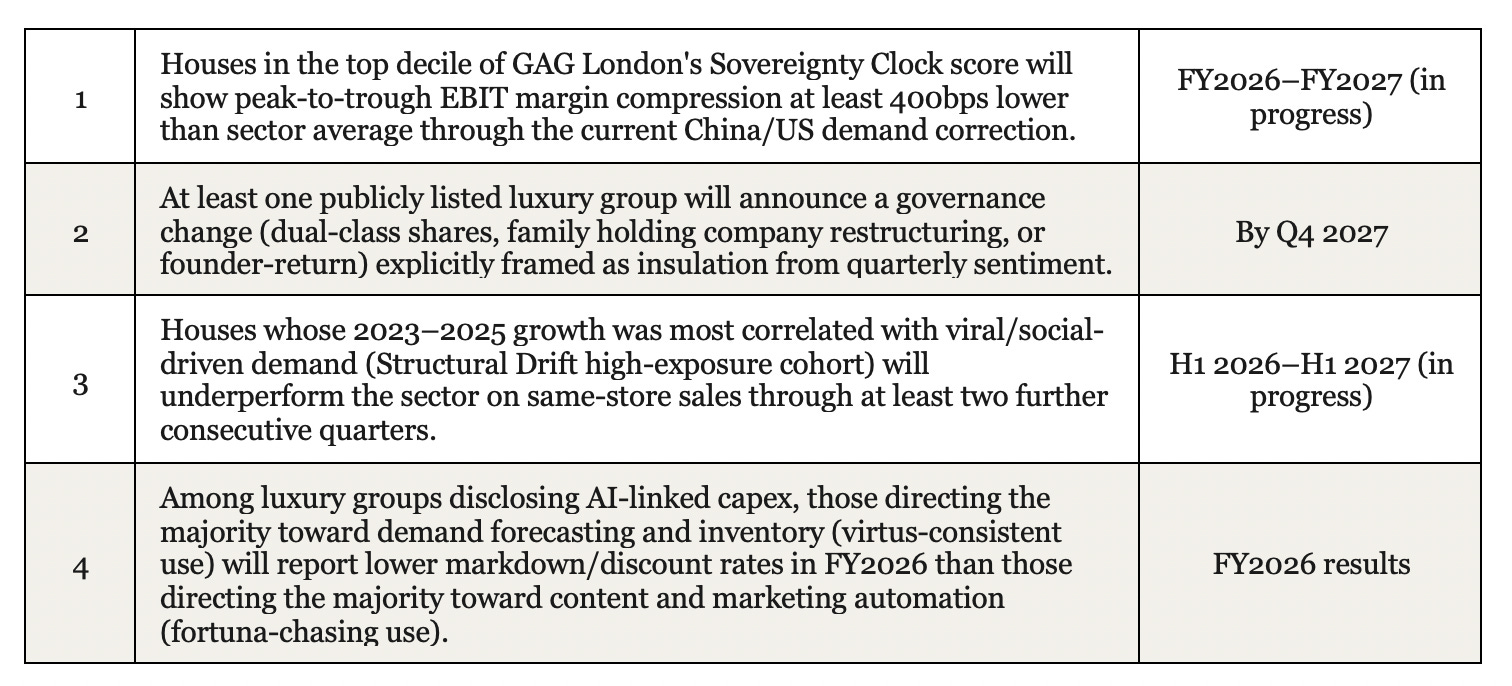
FALSIFIABLE PREDICTIONS
Editorial note on timing: this piece is dated August 2026. Predictions 1 and 3 are therefore already partway through their measurement window and should be read as hypotheses under active, in-progress tracking rather than clean forward bets; only Prediction 2 carries its full stated horizon ahead of publication.
CODA — THE AI FORK: SAME TEST, NEW INSTRUMENT
A fresh data point from this month’s trade press sharpens the argument rather than complicating it. Global AI investment is on track to reach $2.59 trillion in 2026, up 47% on 2025 (Gartner), yet luxury’s own advisors concede the returns so far are thin: fewer than 20% of sector executives report a significant impact from AI deployments to date (Bain & Comité Colbert), with the open challenge being to move past pilots into structural change. The timing is pointed this capital is arriving into a sector Bain and Altagamma expect to grow only 2% to 4% in 2026, meaning AI is being adopted less as a growth lever than as a margin-defence instrument.
The adoption curve itself is quantifiable, and it is steep: AI has moved from a top-three strategic priority for just 5% of luxury companies in 2024 to 22% in 2026 (Bain & Comité Colbert), while 82% of high-spending luxury consumers report having already used AI tools somewhere in their purchase journey. The gap between intent and maturity is the more telling number 92% of organisations plan to increase GenAI investment, but only 1% consider their current systems genuinely mature (McKinsey) which is itself consistent with this editorial’s Independence Tax framing: most of the sector is still paying the cost of experimentation without having banked the scarcity or margin benefit yet.
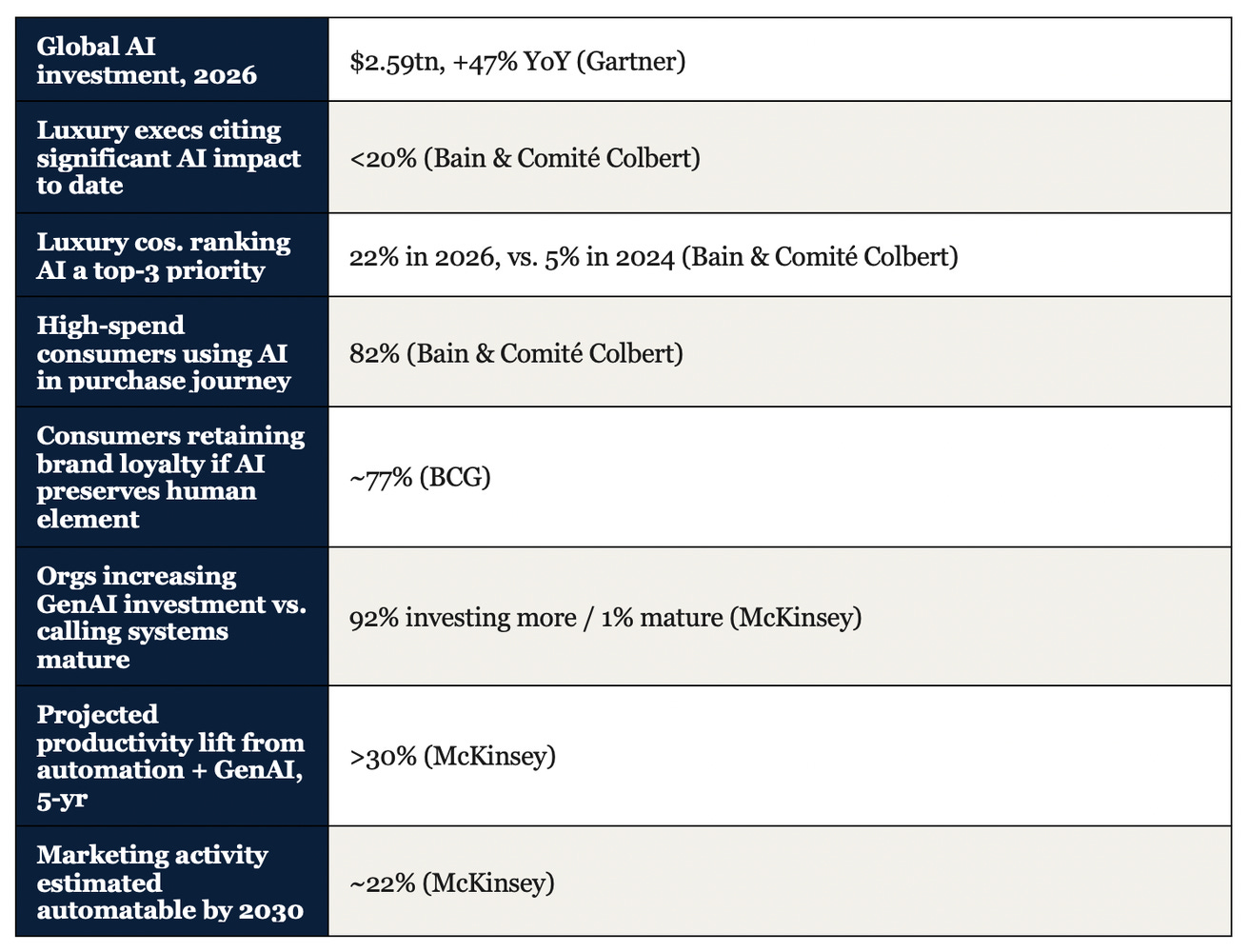
That framing is itself a fortuna/virtus fork. AI spent chasing algorithmic content velocity the Zalando model, which reportedly cut image-production cost by roughly 90% and compressed timelines from six-to-eight weeks to three-to-four days (McKinsey), with about 70% of Q4 2024 editorial content AI-generated optimises for the crowd’s attention cycle Seneca warned against: faster, cheaper, more responsive to trend, which is precisely the Structural Drift exposure this editorial’s Bear case flags. AI spent defending scarcity discipline is different in kind. Zegna’s client-advisor platform, built with Microsoft, shares new arrivals and personalised styling recommendations through the same advisor relationship rather than replacing it technology in service of the relationship a Genius Lock house already owns, not a substitute for it. Consumer sentiment appears to price this distinction correctly: roughly three-quarters of luxury consumers surveyed by BCG say they would stay with a brand using AI or GenAI provided it improves the experience without removing the human element that defines luxury in the first place.
The operational case for virtus-consistent AI is strongest exactly where GAG London’s Independence Tax framework already looks: demand forecasting, inventory and collection planning, where McKinsey estimates automation and GenAI could lift productivity by more than 30% over the next five years, against a backdrop where roughly 30% of working time across Europe and the US is projected to be automatable by 2030. A forecasting error in luxury does not just cost margin it forces discounting, and discounting is fortuna’s preferred method of extracting virtus from a house that let scarcity slip. Used this way, AI is not a new variable in the Stoic model; it is a more precise instrument for doing what the Sovereignty Clock already rewards: fewer forced decisions, made on the house’s own terms rather than the market’s. Prediction 4 above exists to test this directly rather than leave it as illustration.
Seneca’s counsel to Lucilius was never that difficulty should be avoided. It was that character, once genuinely built, cannot be repossessed by circumstance. The luxury houses now discovering that a decade of favourable fortuna was mistaken for permanent strength are relearning, in balance-sheet terms, what Letter 98 stated as doctrine two thousand years ago: the only durable asset is the one the market cannot take away because it was never the market’s to give.
Armando Zuccali | Strategic Advisor in the Luxury & Consumer Sector | Editorialist & Analyst
DISCLAIMER — METHODOLOGICAL NOTE
This editorial is an independent analysis based exclusively on publicly available information as of 11 August 2026, including the classical primary source (Seneca, Epistulae Morales ad Lucilium, Letter 98), published research and data from Gartner, Bain & Company and Comité Colbert, McKinsey & Company and Boston Consulting Group (BCG), and the comparative sources listed below.
All historical descriptions, corporate strategies, governance structures, product initiatives, market data and attributed commentary discussed in this editorial derive exclusively from publicly available information, including company announcements, official company sources, published industry research and trade and financial press reporting. Any analytical interpretation concerning brand strategy, governance philosophy, competitive positioning or the application of Stoic philosophy to corporate valuation represents the author’s independent assessment of those publicly observable facts.
Any observations, estimates, forecasts or analytical frameworks identified as GAG London, including but not limited to Genius Lock, Sovereignty Clock, Patience Premium, Structural Drift and Independence Tax, represent the author’s independent interpretation, are opinion-based, and should be read solely as an interpretive research tool rather than an independently validated industry metric. The Falsifiable Predictions set out in this editorial are forward-looking hypotheses under active, in-progress testing and do not constitute forecasts, guarantees or investment recommendations.
NATURE OF THIS PUBLICATION
This publication is an independent editorial analysis intended exclusively for educational, analytical and informational purposes.
Nothing contained herein constitutes investment advice, financial promotion, valuation advice, commercial endorsement, or professional consulting. This editorial does not allege wrongdoing by LVMH, Kering, Richemont, Ermenegildo Zegna Group, Hermès, Chanel, Brunello Cucinelli, Loro Piana, Zalando, Microsoft, Gartner, Bain & Company, Comité Colbert, McKinsey & Company, Boston Consulting Group, or any other company, brand or individual named or implied in the text. The article expresses independent analytical opinions based exclusively upon publicly available information.
DISCLOSURE OF INTERESTS
At the time of publication, neither the author nor GAG London Equity Capital Ltd has any commercial relationship with LVMH, Kering, Richemont, Ermenegildo Zegna Group, Hermès, Chanel, Brunello Cucinelli, Loro Piana, Zalando, Microsoft, Gartner, Bain & Company, Comité Colbert, McKinsey & Company, Boston Consulting Group, or any other company, executive, shareholder, competitor or entity named or implied in this editorial, nor any financial interest that could reasonably be considered to influence the conclusions expressed herein.
GAG London Equity Capital Ltd provides independent strategic advisory services within the international luxury, branded consumer goods and branded-markets industries. Any analytical conclusions contained in this publication represent solely the author’s independent editorial opinion and should not be interpreted as commercial promotion, endorsement, accusation or investment recommendation.
SOURCES
This editorial is based exclusively upon publicly available material, including but not limited to:
— Seneca, Epistulae Morales ad Lucilium, Letter 98 (c. 62–65 CE), classical primary text;
— Published research and data from Gartner on global AI investment (2026);
— Published research and data from Bain & Company and Comité Colbert on AI adoption in the luxury sector (2026);
— Published research and data from McKinsey & Company on GenAI investment, productivity and workforce automation;
— Published research and data from Boston Consulting Group (BCG) on consumer sentiment toward AI in luxury;
— Official company sources and public statements by LVMH, Kering, Richemont, Ermenegildo Zegna Group, Hermès, Chanel, Brunello Cucinelli, Loro Piana, Zalando and Microsoft;
— Trade and financial press reporting.
Where corporate or institutional commentary is discussed, it refers exclusively to statements made publicly through announcements, interviews, trade press, or other publicly accessible sources.
ABOUT THE AUTHOR
Armando Zuccali is Founder & Chief Executive Officer of GAG London Equity Capital Ltd, an independent strategic advisory and equity capital platform with offices in London, Barcelona, Milan and Hong Kong, specialising in luxury goods, fashion retail, branded consumer businesses and strategic corporate analysis.
He is the author of the Monday Editorial Series, an independent body of long-form research examining corporate strategy, governance, capital allocation, brand economics and structural transformation across global consumer and luxury industries. His editorial work is intended for institutional investors, family offices, executives, founders and corporate boards seeking deeper strategic analysis of the evolving consumer and luxury sectors.
The proprietary analytical frameworks referenced throughout this publication form part of GAG London’s independent research methodology.
Commenti
Impostazioni commenti

1

Consiglia
Commenta
Condividi
Aggiungi un commento…
Apri tastiera Emoji
Ancora nessun commento.
Scrivi tu il primo commento.
Avvia la conversazione