THE GENIUS LOCK
How a Handful of Solitary Watchmakers Broke the Luxury Playbook — and Why Capital Is Only Now Pricing It Correctly

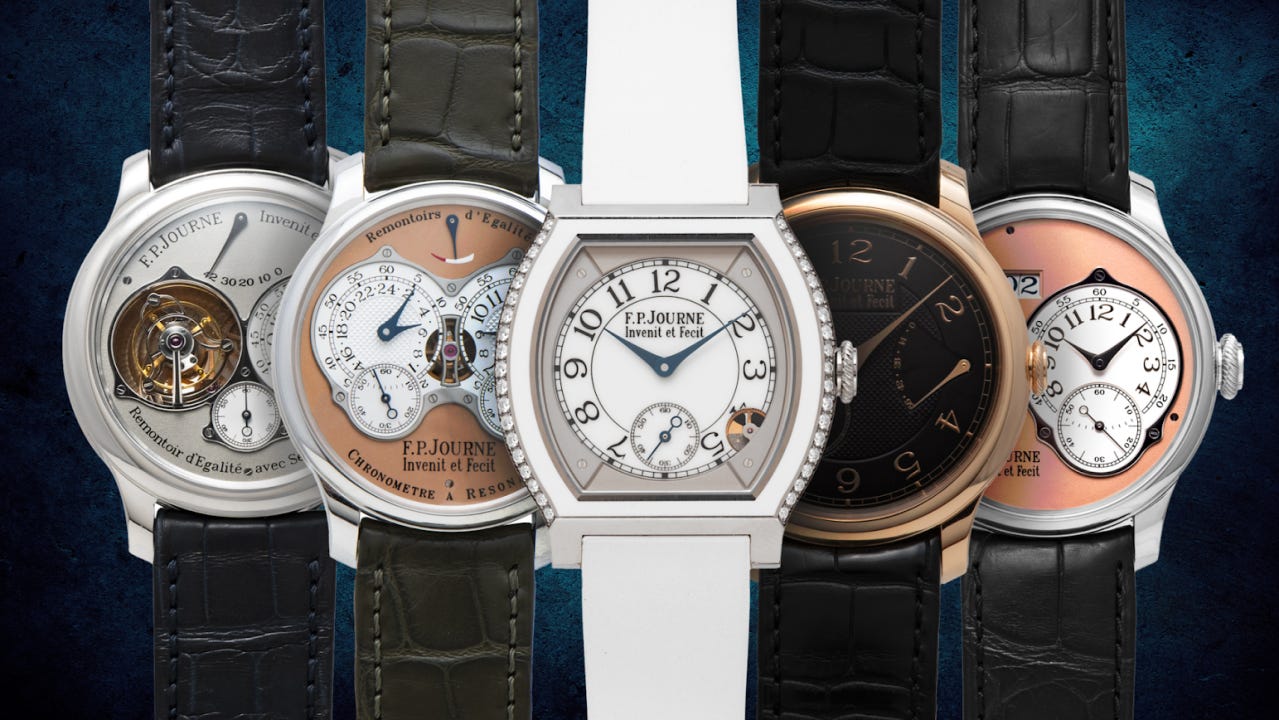
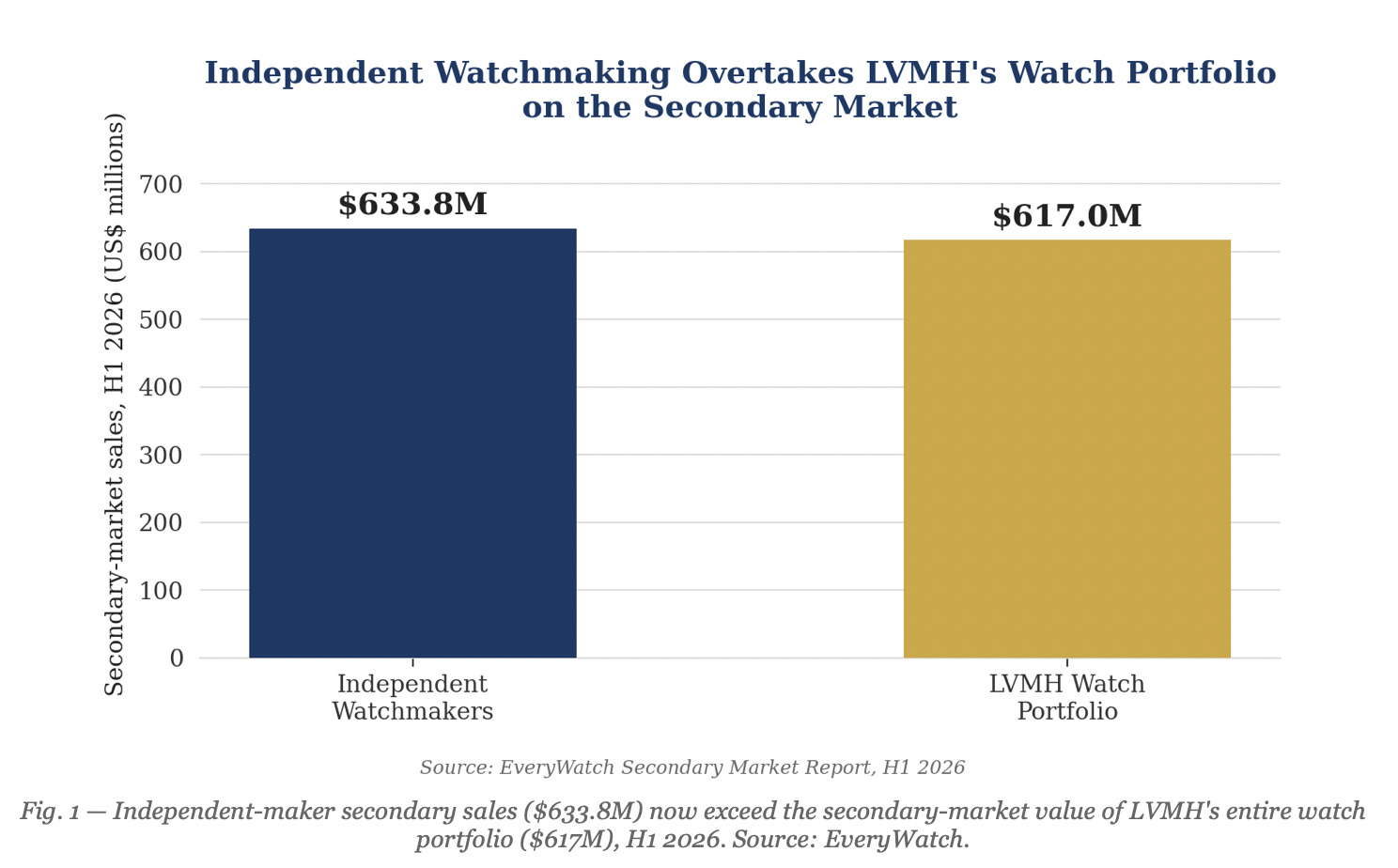
There is a category of asset in luxury that no conglomerate can manufacture, no acquisition can accelerate, and no marketing budget can compress into a shorter waiting list. It is the output of a single pair of hands, working at a bench that produces, in a good year, somewhere between twenty and a thousand finished objects for the entire world. In 2026, that category has quietly become the fastest-growing, best-performing corner of the luxury secondary market — outgrowing Rolex, outgrowing Patek Philippe, and, on the numbers, outgrowing the entire watch portfolio of LVMH. This editorial makes the case that independent watchmaking is no longer a curiosity for obsessives. It is a distinct, investable asset class with its own mechanics, its own risk profile, and its own name for what drives it. GAG London calls it the Genius Lock.

I. The Bifurcation Made Visible
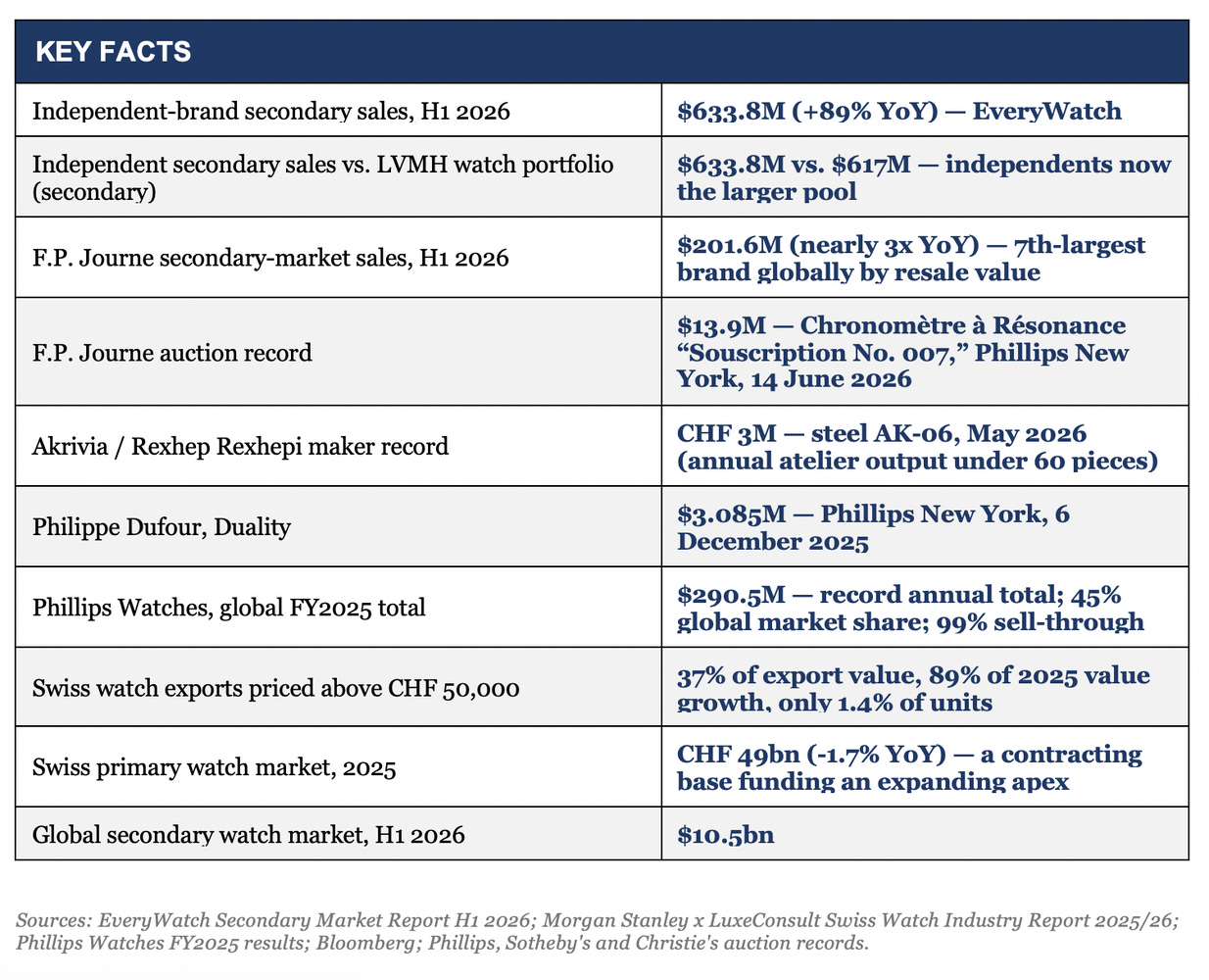
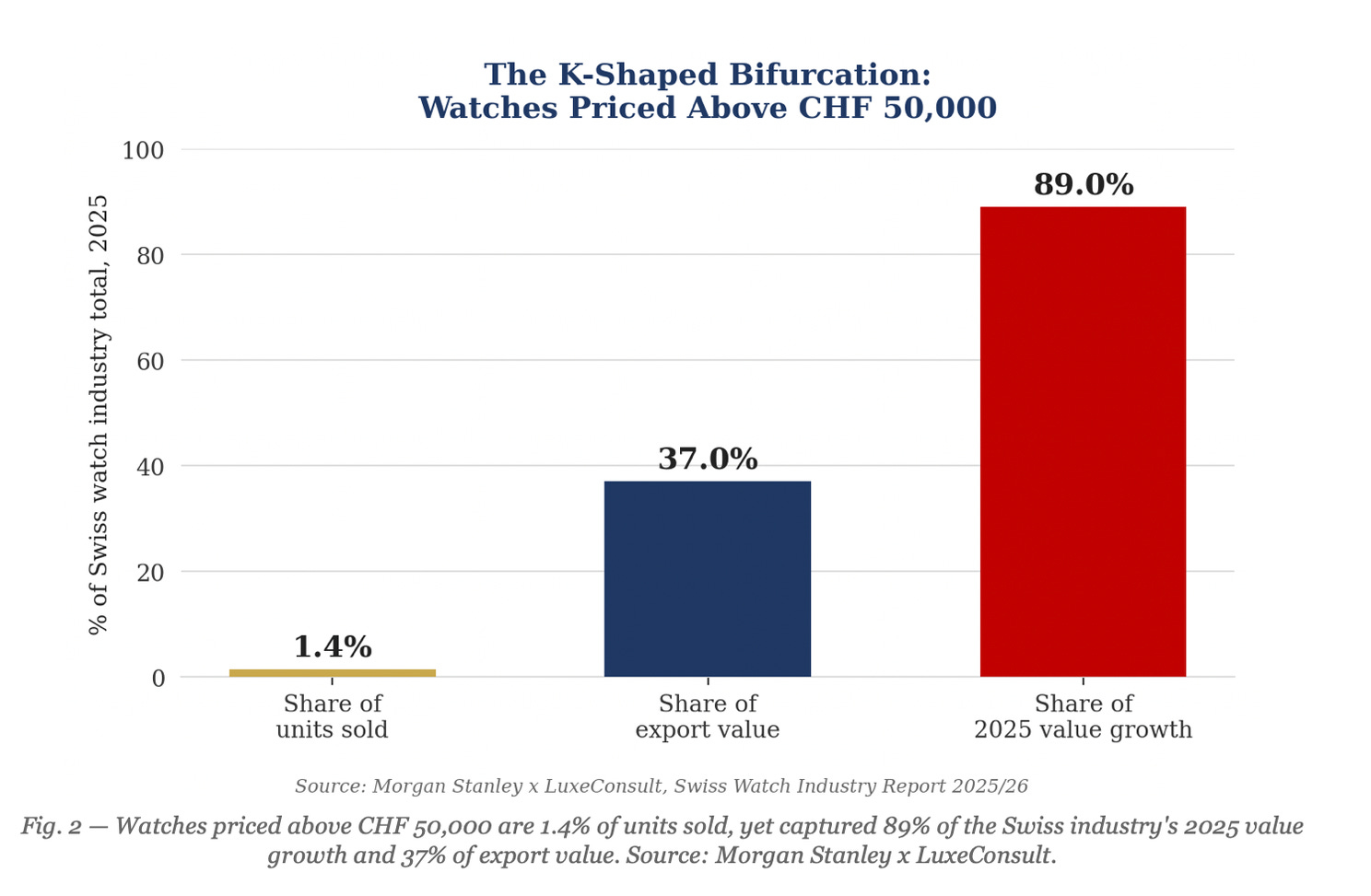
Readers of this series will recognise the shape of this story before they read the numbers, because it is the shape of every luxury category GAG London has covered since the Veblen 2.0 framework was first set out: growth concentrates at the extreme top, while the middle erodes. What the watch industry offers in 2026 is the cleanest empirical confirmation of K-Shaped Bifurcation yet produced. Morgan Stanley and LuxeConsult find that watches priced above CHF 50,000 accounted for just 1.4% of units sold by the Swiss industry in 2025, yet delivered 89% of the industry’s value growth and 37% of total export value. Meanwhile the broad primary market the CHF 49bn base that includes everything from entry steel sports watches to mid-tier complications — contracted by 1.7%. This is not a booming industry. It is a shrinking industry with one violently expanding compartment, and independent watchmaking sits at the very top of that compartment, above even the hard luxury flagships of the conglomerates.
The mechanism is familiar from fashion, from fine jewellery, from art: when a market bifurcates, capital does not distribute itself evenly across the survivors — it re-concentrates around whatever asset offers the most credible, least reproducible form of scarcity. In hard luxury, that asset used to be the manufacture name on the dial. Increasingly, it is the name of the human being who built the movement.
II. Credible Scarcity, Not Staged Scarcity
I’ve written before, in the context of fine jewelry and leather goods, about the difference between credible scarcity and its cheapest imitation: the seasonal “limited edition” that a conglomerate can, in principle, always produce more of. Independent watchmaking is the purest test case in luxury for that distinction, because the constraint is not a marketing decision. It is a biological and physical one: one person, one bench, a finite number of hours in a career.
F.P. Journe produces under 1,000 watches a year across an entire maison. Rexhep Rexhepi’s Atelier Akrivia produces fewer than 60. Philippe Dufour, across a working career that effectively spans four decades, completed something in the order of 200 examples of his Simplicity the reference on which his reputation as “the watchmaker’s watchmaker” was built before winding down new commissions almost entirely. These are not numbers a boutique or a brand-management committee decided upon for the sake of desirability; they are the ceiling imposed by what a small workshop, or a single craftsman, can physically finish by hand to the standard the market has come to expect. That ceiling cannot be raised by a change in corporate strategy the way a conglomerate can quietly widen an allocation. It is the rarest thing luxury economics ever produces: scarcity that is genuinely, structurally, expensively real.

The market has begun to price this distinction with unusual clarity. Phillips’ 2025 result — $290.5 million across the year, a 99% sell-through rate by lot and effectively full sell-through by value — was not built primarily on volume; it was built on a small number of trophy lots clearing at prices that repeatedly beat estimate by 80–140%, a pattern that recurs across nearly every recorded Dufour and Rexhepi sale of the past eighteen months. When beat-to-estimate performance is this consistent across an entire category rather than a single lot, it stops being noise and starts being a signal: the market is systematically under-anchoring independent watchmaking relative to where clearing prices land.
III. The Genius Lock
This is the framework GAG London proposes to formalise what is happening beneath these numbers. The Genius Lock describes an asset whose value is bound irreversibly to a single named, living or historically documented human maker, such that the asset cannot be replicated, extended, or reissued by any corporate successor — including, critically, a successor who legally owns the brand name itself.
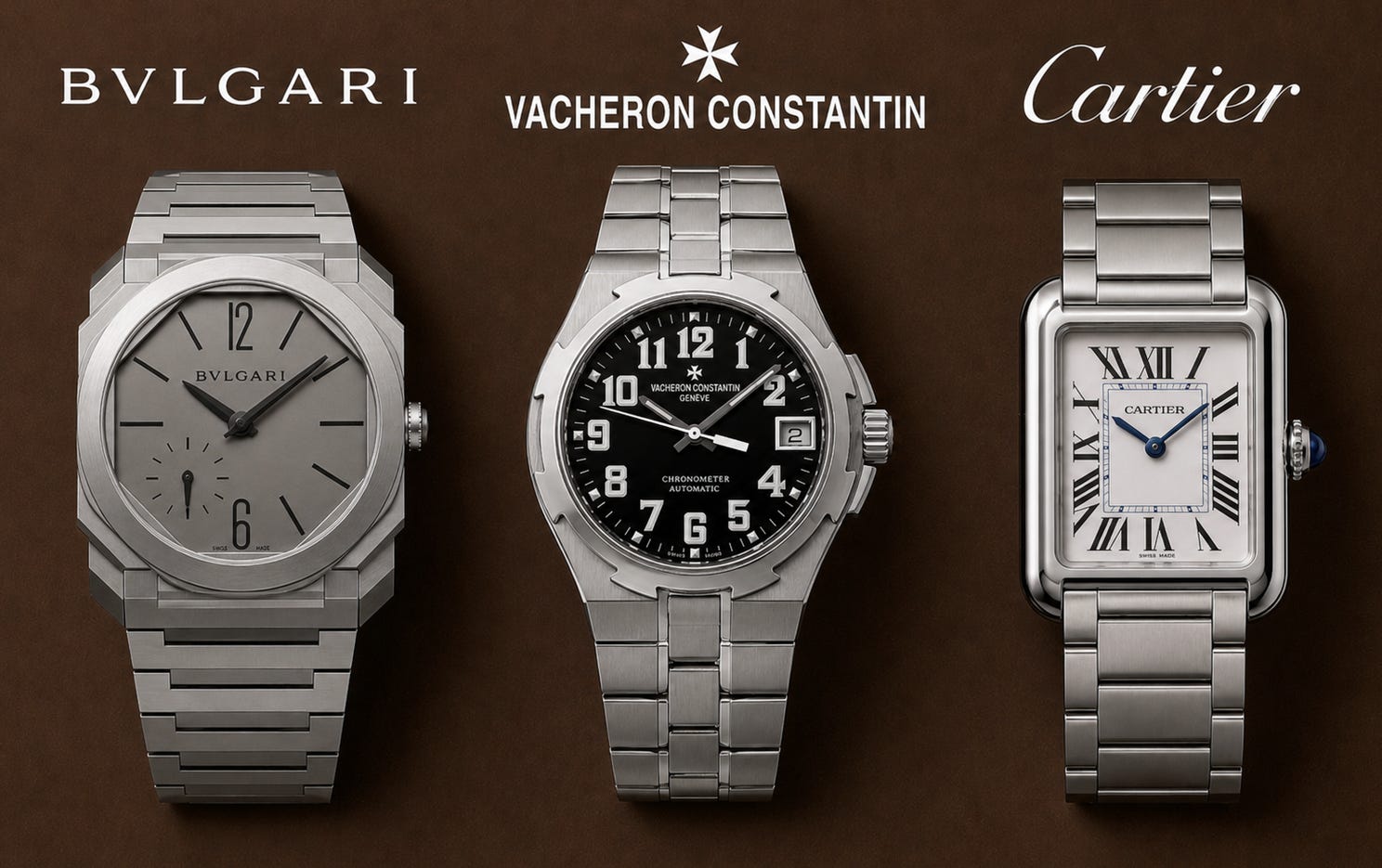
A conglomerate’s scarcity is rented. It can be extended, contracted, or reissued at the discretion of a board. A Genius Lock cannot. When Bulgari, Cartier or Vacheron Constantin release a “limited edition of 100,” the number 100 is a decision made in a marketing meeting, and it can be revisited in the next one. When Philippe Dufour finishes his two-hundredth Simplicity, or when Rexhep Rexhepi’s atelier delivers its sixtieth watch of the year, the number is not a decision — it is a fact about the number of hours a finisher can spend, by hand, under a loupe, on a single balance cock. No acquisition, no capital injection, no expansion of the workforce can move that number materially without destroying the very thing that makes the object valuable, because the value is the labour itself, not the badge attached to it.

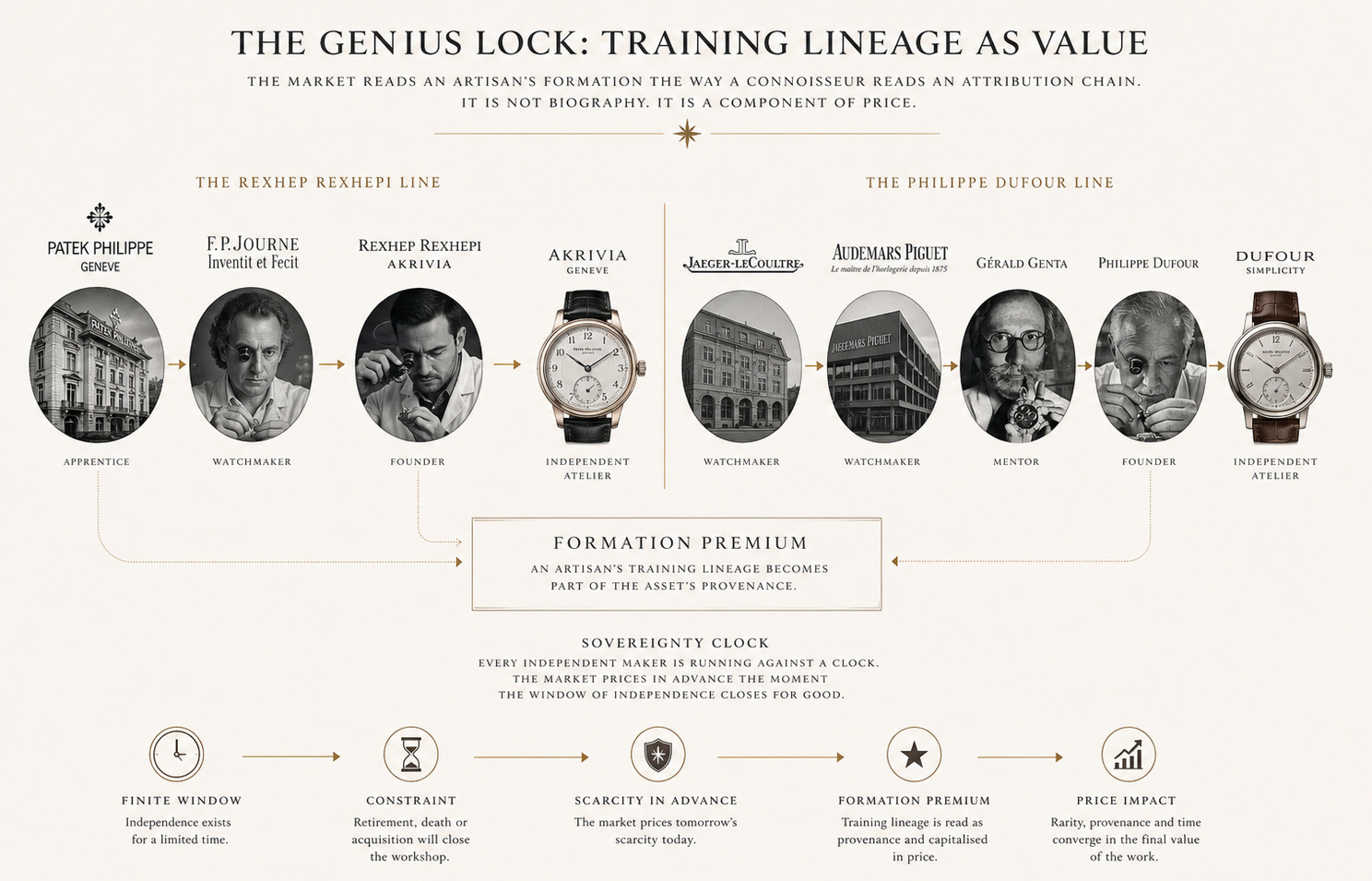
This is why the Genius Lock sits logically downstream of two frameworks GAG London has used elsewhere in this series. It draws on Formation Premium — the idea that an artisan’s training lineage becomes part of the asset’s provenance, the way a pupil of a recognised Old Master carries attribution value independent of the finished work itself. Rexhep Rexhepi trained at Patek Philippe and then at F.P. Journe before founding Akrivia; Philippe Dufour cut his teeth at Jaeger-LeCoultre, Audemars Piguet and under Gérald Genta before opening his own atelier in the Vallée de Joux. The market is increasingly capable of reading these lineages the way a connoisseur reads an attribution chain in an Old Master sale — not as biography, but as a component of price. It also draws on Sovereignty Clock, the framework this series has used to describe the finite window during which a house remains independent before capital, succession pressure or a conglomerate acquisition changes its status permanently. Every independent maker is, in this sense, running against a clock that the market has started to price in advance: rarity today is partly a bet on constrained supply tomorrow, when either retirement, death, or acquisition closes the workshop door for good.
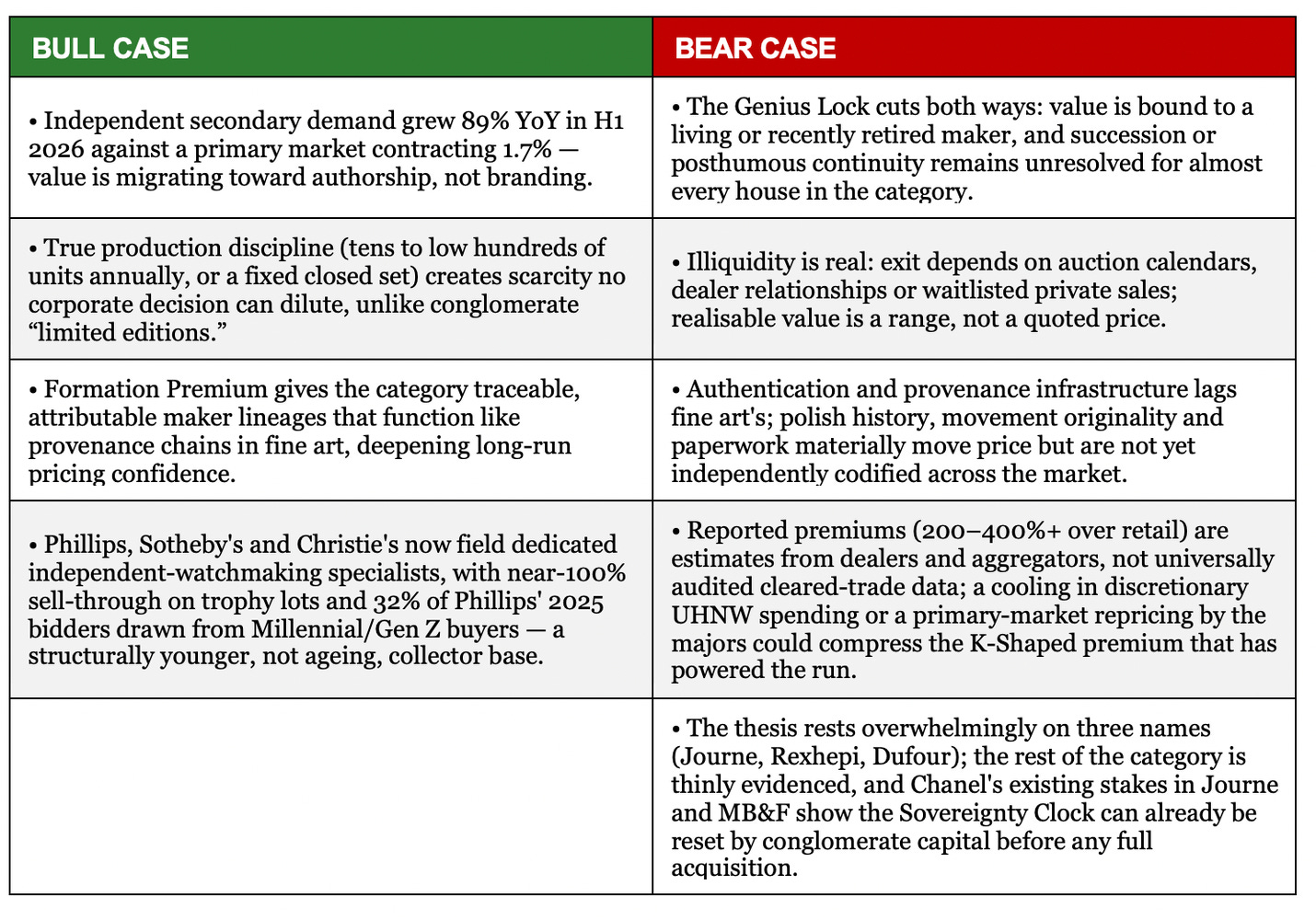
The Lock is also not absolute, and treating it as such would be a category error. Chanel has held a 20% stake in F.P. Journe since 2018 and has more recently invested in MB&F — direct evidence that conglomerate capital is already inside the independent tier, not merely circling it from outside. A minority stake is not a takeover, and Journe has been explicit that design and production autonomy remain intact, but it establishes a precedent the thesis has to sit with: the Sovereignty Clock can be reset by a strategic investment long before any full acquisition, and the market has not yet worked out how much of the Genius Lock premium survives that transition. Nor is production discipline necessarily permanent. An atelier facing sustained seven-figure demand has every incentive, at the margin, to add a bench, train an apprentice into a production role, or quietly extend a waiting list rather than close it — and each of those choices, however small and however well-intentioned, is a genuine dilution risk that a pure scarcity thesis has to acknowledge rather than assume away.
IV. The Names on the Bench
The auction results of the past eighteen months read like a changing of the guard, with three names doing most of the work of proving the thesis.
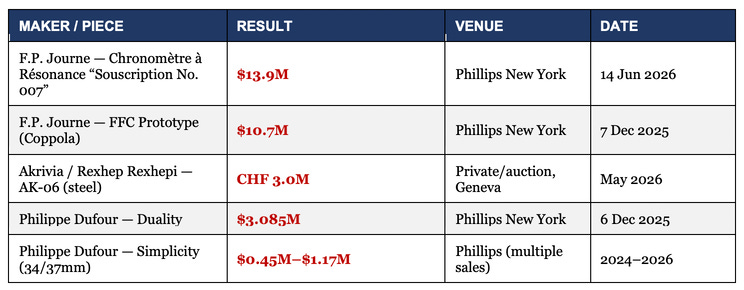
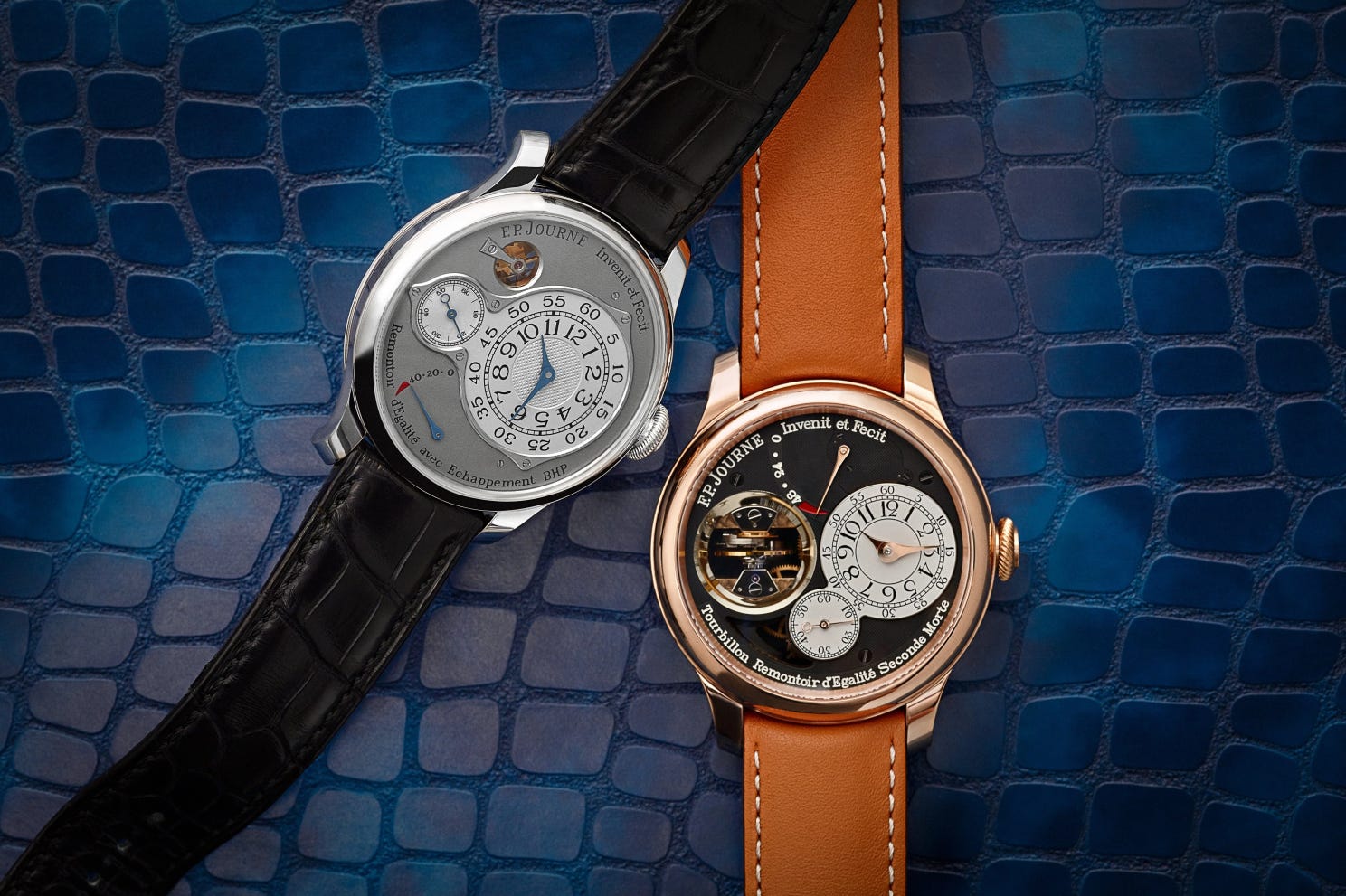
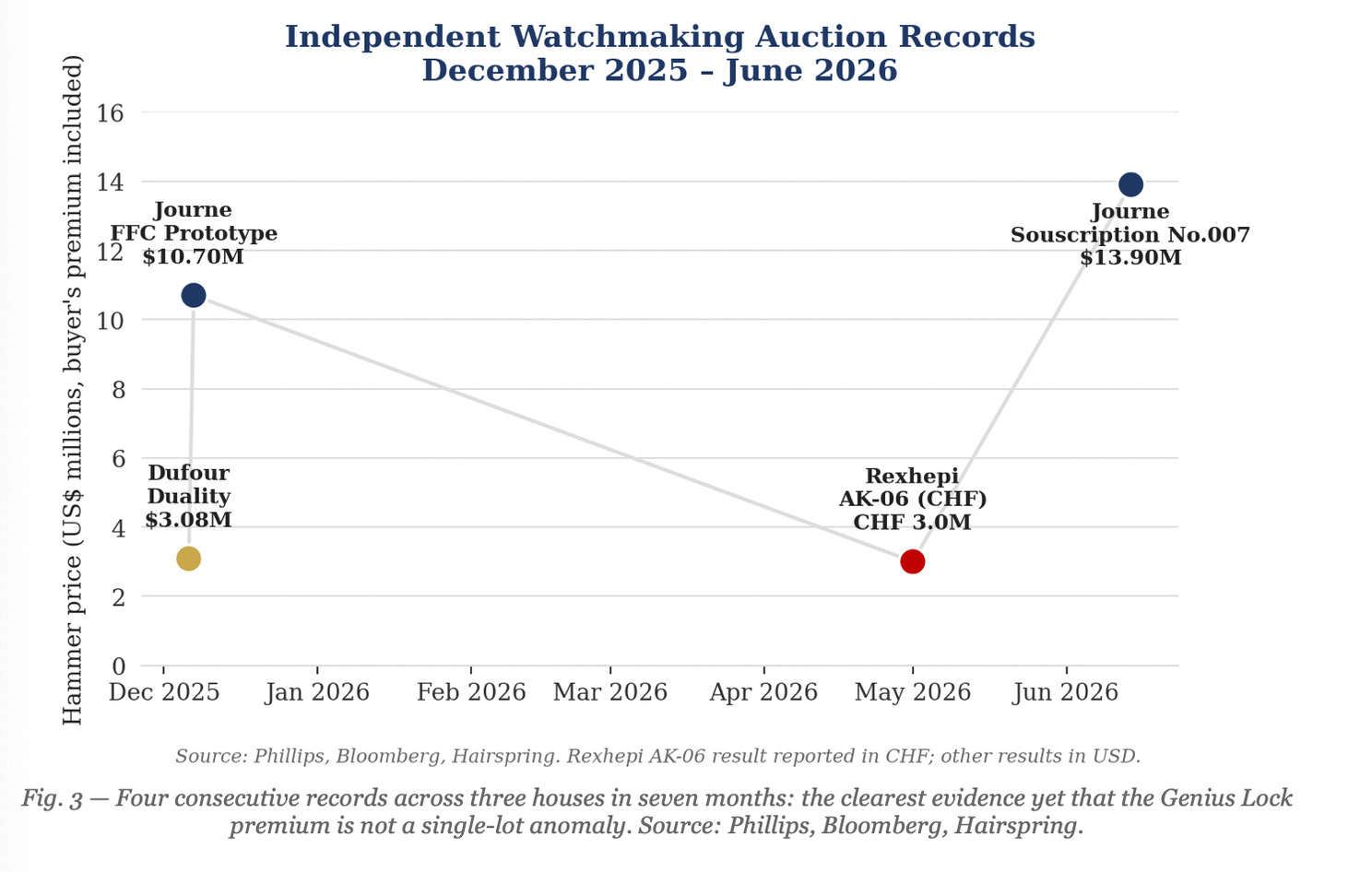
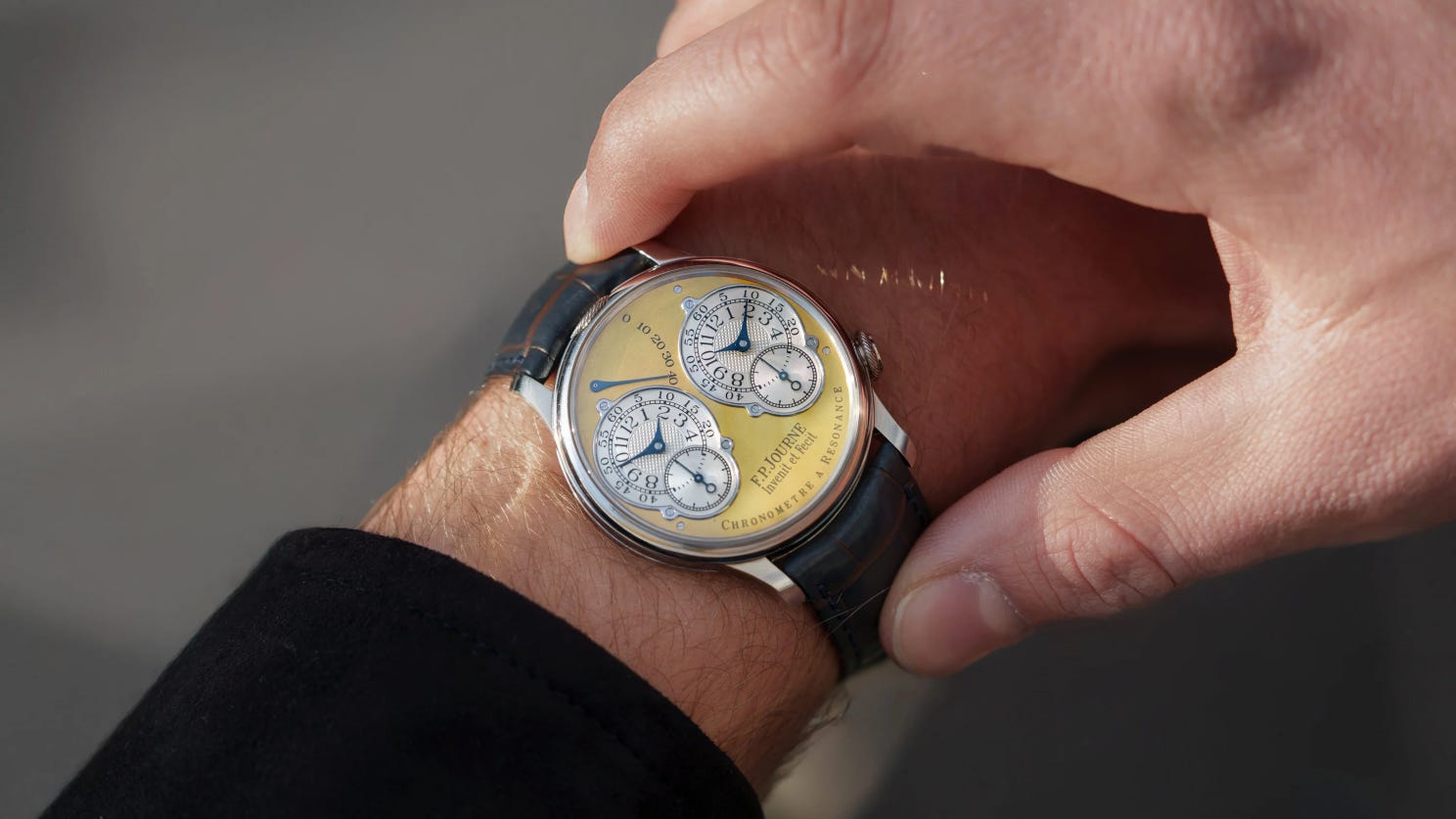
F.P. Journe is the bellwether because it is furthest along the path from cult object to institutional asset: 27 years old, under 1,000 pieces a year, and now the seventh-largest watch brand in the world by secondary-market value — ahead of houses that produce a hundred times its volume. Its June 2026 result at Phillips, $13.9 million for a Chronomètre à Résonance from the founding Souscription series, is not simply a record for the maison; it is one of the highest prices ever paid for a wristwatch that was never a one-off charity commission, which matters, because it demonstrates depth of demand for production references, not just for unique pieces built for a cause.
Rexhep Rexhepi is the proof of replicability of the thesis, not the exception to it. A Kosovar watchmaker in his late thirties, trained under Patek Philippe and then Journe before founding Akrivia in 2012, has in the space of roughly a decade moved from niche respect among specialists to seven-figure and now eight-figure-adjacent hammer prices, on an annual output the industry still measures in the dozens. Demand for his current Chronograph Flyback reference reportedly ran to more than 1,700 requests against fewer than sixty watches of annual capacity across the entire atelier — a request-to-delivery ratio that a listed luxury group would consider a headline KPI, not a footnote.

Philippe Dufour is the thesis’s clearest statement of terminal scarcity. Now in his late seventies and largely retired from new commissions, his back-catalogue — roughly 200 examples of the Simplicity built across a career, plus a handful of grande sonnerie and Duality pieces numbered in single and low-double digits — is a closed set in the way a deceased painter’s oeuvre is closed. Every subsequent auction result is, by definition, trading against a fixed and now-diminishing supply, with no possibility of a later production run correcting an over-enthusiastic price.

Beyond the Triumvirate — and Its Risk
The narrative risk in this argument is obvious and should be named directly, not buried: Journe, Rexhepi and Dufour are three names carrying nearly the entire evidentiary weight of this editorial, and three data points, however dramatic, are not a diversified sample. GAG London treats this as the single largest methodological weakness in the Genius Lock thesis, not an incidental caveat to file away in the fine print.
The June 2026 Phillips sale that produced the Journe Souscription No. 007 record is, on this point, a useful stress test rather than a comfortable confirmation: the same sale also set new individual auction records for Kari Voutilainen and Roger W. Smith, two makers who do not otherwise appear in this piece’s data. That is a first, thin data point suggesting the premium is broadening rather than concentrating — not proof of it. Separately, Morgan Stanley and LuxeConsult’s 2025 brand estimates show H. Moser & Cie. and MB&F both growing revenue for the year alongside Journe, indicating the commercial base beneath the auction headlines is wider than three ateliers. But none of this yet rises to the standard of evidence GAG London applied to the top three. Until Voutilainen, Petermann Bédat, De Bethune, Grönefeld and MB&F produce a comparable density of repeat, seven-figure-plus auction results, the Genius Lock should be read as a demonstrated phenomenon in three ateliers and a plausible, not yet proven, hypothesis for the category as a whole. Prediction 2 below is written specifically to make that distinction falsifiable rather than asserted.
V. What Investors Are Actually Buying
It is worth being precise about what changes hands in this market, because it is not equity, and it is not, in most cases, even a conventional retail purchase. Access to a Journe, a Rexhepi, or — historically — a Dufour piece runs through allocation, not open sale: reported waits of two to seven years for collectors already known to an atelier, waitlists that boutiques describe as effectively closed to new names, and a secondary market where premiums of 200% to 400% over retail are common for the most sought references. What an investor is really buying, in most transactions, is not the watch at the moment of acquisition but the right to eventually own an asset whose supply curve is fixed and whose demand curve, on the last three years of data, only steepens.
This has real portfolio-construction implications. Unlike listed luxury equities, there is no daily marking-to-market; realizable value is a range bounded by dealer offers, auction estimates and private-sale comparables, not a single clearing price. Unlike fine art, there is not yet a codified, universally trusted attribution and condition infrastructure — provenance verification, movement authentication and polish/refinishing history matter enormously to realised price, and the specialist ecosystem that certifies these details (principal dealers, atelier archives, the two or three recognised private-sale desks) is still comparatively young and thin relative to the equivalent infrastructure in the art market. Liquidity, in other words, is real but structured, seasonal, and relationship-dependent — closer to how a serious collector would describe buying into a closed-end vehicle than a public one.
None of this makes the category suitable, in its current form, for a scaled institutional allocation, and this editorial should not be read as suggesting otherwise. A family office or an institutional buyer accustomed to entering and exiting positions in size, on a timetable it controls, will find independent watchmaking closer to a specialist, relationship-gated sleeve than to a liquid alternative asset: allocation is won through years of boutique relationship rather than capital committed, exit runs through a handful of dealers and roughly two auction seasons a year, and there is no mechanism to build or unwind a meaningful position quickly at a defensible price. This is a category for patient, relationship-literate capital in single-digit-million sleeve sizes — not, at least not yet, for a mandate seeking to deploy nine or ten figures with any predictability of entry or exit price.
VI. Three Falsifiable Predictions
Prediction 1. Base case, not a certainty: aggregate independent-brand secondary sales, currently running at $633.8M in H1 2026, annualise above $1.2bn for full-year 2026 and sustain year-on-year growth above 30% into H1 2027. This assumes no material contraction in UHNW discretionary spending and no repricing shock in the wider luxury complex; a global risk-off event or a sharp Chinese/Hong Kong demand pullback — already a drag on 2025 primary-market performance — would be sufficient to break it. We will treat this prediction as falsified, not merely missed, if H1 2027 growth comes in below 15%.
Prediction 2. Within 24 months, at least one currently sub-$5M-record independent maker outside the Journe/Dufour/Rexhepi triumvirate — most plausibly Kari Voutilainen, Petermann Bédat, or Simon Brette — will cross the $2 million threshold for a single lot at a major auction house, evidencing that the Genius Lock premium is broadening across the category rather than concentrating in three names.
Prediction 3. If Atelier Akrivia’s annual output does not expand materially beyond its current sub-60-piece ceiling by the end of 2027, further Rexhep Rexhepi secondary-market records will follow within twelve months of any new reference launch — confirming that production discipline, not softening demand, remains the binding constraint on price.
Analytical Notes
This editorial is written from GAG London’s own analytical framework and forms part of a proprietary series; the Genius Lock is our terminology, not an industry-standard classification, and readers should treat it, and the K-Shaped Bifurcation lens applied throughout, as an argued thesis rather than neutral reporting. We have tried to hold the data to the same evidentiary standard we would apply to a client mandate, including naming explicitly where the evidence is thin (see “Beyond the Triumvirate” above) — but the framing itself is ours, and is intended, in part, to be useful to GAG London’s own positioning in this space.
Figures are compiled from EveryWatch’s H1 2026 Secondary Market Report (based on approximately 650 dealers and nearly 500 auction houses), the Morgan Stanley x LuxeConsult Swiss Watch Industry Report 2025/26, and Phillips’ own FY2025 results disclosure. Where a valuation is described as a desk estimate (for example, private-sale comparables cited by specialist advisory desks) rather than a cleared auction result, it should be read as indicative, not as an audited transaction price.
Currency figures mix USD and CHF depending on the originating auction house and reporting jurisdiction; conversions follow the rate disclosed at the time of each respective sale and have not been restated to a single base date.
Premium ranges (200–400% over retail) reflect boutique-adjacent secondary listings and dealer commentary rather than a single audited index, and should be treated as directional rather than precise.
Armando Zuccali | Strategic Advisor in the Luxury & Consumer Sector | Editorialist & Analyst
DISCLAIMER — METHODOLOGICAL NOTE
This editorial is an independent analysis based exclusively on publicly available information as of 12 June 2026, including auction results and pre-sale estimates published by Phillips, Christie’s and Sotheby’s, secondary-market pricing data from Unpolished/SJX Watches, Chrono24 and WatchCharts, gold price data and institutional forecasts from Goldman Sachs and JPMorgan, and the comparative sources listed below.
All historical descriptions, auction results, secondary-market pricing figures, production-volume estimates and gold-price data discussed in this editorial derive exclusively from publicly available information, including the sources named above and third-party trade and financial press reporting explicitly identified as such throughout. Any analytical interpretation concerning market structure, founder-transition risk, scarcity economics or capital allocation represents the author’s independent assessment of those publicly observable facts. Where this editorial characterises a figure as a GAG London estimate, a forward-looking scenario, or a third-party institutional forecast — including the gold-price scenarios above $5,000/oz cited from Goldman Sachs and JPMorgan — this is explicitly labelled as such throughout and should not be read as Phillips, Christie’s, Sotheby’s, or any named institution’s own guidance.
Any observations, estimates, forecasts or analytical frameworks identified as GAG London — including Perceptual Capital and Credible Scarcity — represent the author’s independent interpretation, are opinion-based, and should be read solely as an interpretive research tool rather than an independently validated industry metric.
NATURE OF THIS PUBLICATION
This publication is an independent editorial analysis intended exclusively for educational, analytical and informational purposes. It is not financial, investment, legal, tax or accounting advice. All views, probabilities and forward-looking statements — including the gold-price scenarios and the capital allocation considerations set out in this editorial — are the author’s subjective estimates based on public data and carry significant uncertainty; no representation is made as to their accuracy or completeness. This analysis expresses honest opinion on matters of legitimate public interest and is protected under the Defamation Act 2013 (UK). Any disputes shall be subject to the exclusive jurisdiction of the courts of England and Wales.
Nothing contained herein constitutes investment advice, financial promotion, valuation advice, commercial endorsement, or professional consulting. This editorial does not allege wrongdoing by F.P. Journe S.A., Phillips, Christie’s, Sotheby’s, Goldman Sachs, JPMorgan, or any other named company or individual. The article expresses independent analytical opinions based exclusively upon publicly available information, and explicitly flags, where relevant, the limits of what that information can verify — particularly the uncertainty inherent to forward-looking gold-price projections and to the timing of any founder succession at F.P. Journe.
DISCLOSURE OF INTERESTS
At the time of publication, neither the author nor GAG London Equity Capital Ltd has any commercial relationship with F.P. Journe S.A., Phillips, Christie’s, Sotheby’s, Goldman Sachs, JPMorgan, or any of the other companies, watchmakers, or entities named or implied in this editorial, nor any financial interest that could reasonably be considered to influence the conclusions expressed herein. GAG London Equity Capital Ltd holds no financial interest in F.P. Journe S.A. or any affiliated entity.
GAG London Equity Capital Ltd provides independent strategic advisory services within the international luxury, fashion retail and branded consumer industries. Any analytical conclusions contained in this publication represent solely the author’s independent editorial opinion and should not be interpreted as commercial promotion, endorsement, accusation or investment recommendation.
SOURCES
This editorial is based exclusively upon publicly available material, including but not limited to:
— Auction results and pre-sale estimates published by Phillips, Christie’s and Sotheby’s, current to the date of publication;
— Secondary-market pricing data from Unpolished/SJX Watches, Chrono24 and WatchCharts;
— Gold price data and institutional forecasts, including Goldman Sachs’ end-2026 projection ($4,900/oz) and JPMorgan’s February 2026 revised range ($6,000–$6,300/oz);
— Trade and financial press reporting on the luxury watch secondary market, founder-succession dynamics in independent watchmaking, and precious-metal pricing.
Where corporate or institutional commentary is discussed, it refers exclusively to statements made publicly through interviews, trade press, published research notes, or other publicly accessible sources. Where a valuation is described as a desk estimate or dealer commentary rather than a cleared auction result, this is stated explicitly throughout and is never presented as an audited transaction price.
ABOUT THE AUTHOR
Armando Zuccali is Founder & Chief Executive Officer of GAG London Equity Capital Ltd, an independent strategic advisory and equity capital platform with offices in London, Barcelona, Milan and Hong Kong, specialising in luxury goods, fashion retail, branded consumer businesses and strategic corporate analysis.
He is the author of the Monday Editorial Series, an independent body of long-form research examining corporate strategy, governance, capital allocation, brand economics and structural transformation across global consumer and luxury industries. His editorial work is intended for institutional investors, family offices, executives, founders and corporate boards seeking deeper strategic analysis of the evolving consumer goods and luxury sectors.
The proprietary analytical frameworks referenced throughout this publication form part of GAG London’s independent research methodology.
COPYRIGHT
© 2026 Armando Zuccali – GAG London Equity Capital Ltd. All rights reserved. No part of this publication may be reproduced, distributed or transmitted in any form or by any means, including electronic, mechanical, photocopying, recording or otherwise, without the prior written permission of the author, except for brief quotations used for editorial, academic or review purposes in accordance with applicable copyright laws.